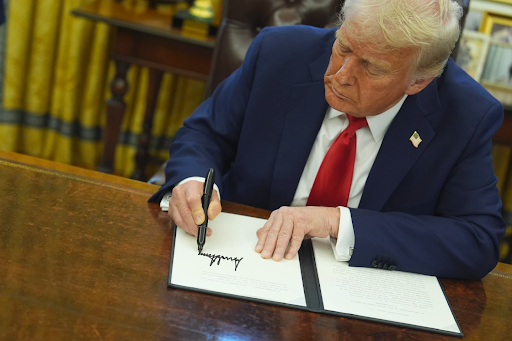
Trump’s first year has been eventful and historical, marked by extensive use of executive actions. The president’s second term focuses on immigration and economic strategy, in which he makes decisions with an “America First” ideology.
January
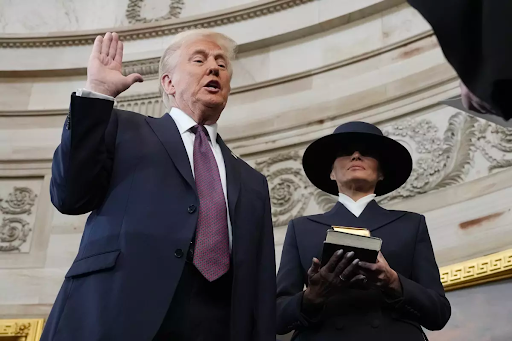
On Trump’s first day in office, he signed nearly 40 executive orders. These orders consisted of topics including social issues, and immigration, where Trump revoked the “Catch-and-Release policy. Now, all individuals arrested related to immigration have to remain in custody and wait for court proceedings. The President attempted to remove the 14th amendment which involves birthright citizenship. He also focused on major social issues like defining gender, and restricting trangender policies. President Trump took this month to pardon many January 6th rioters. January was filled with a fast paced and rapid agenda focused on implementing his “America First” priorities.
February
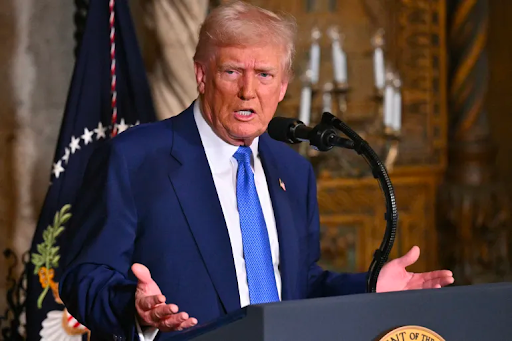
In Trump’s second month in office he continued to reconstruct the government and focus on economics. In February the president introduced new tariffs on other countries. This economic plan consisted of a 25% tariff on all steel and aluminum imports on goods from Canada and Mexico. With the initiation of the tariffs the President received backlash because the tariffs created many difficulties for businesses and led to job losses. One of Trump’s many campaign promises was to end the war in Gaza. The President set a deadline for Israel regarding hostage returns. Trump signed executive orders relating to the Department of Government Efficiency (DOGE). The executive orders led to reductions in the workforce for example the Department of Education.
March
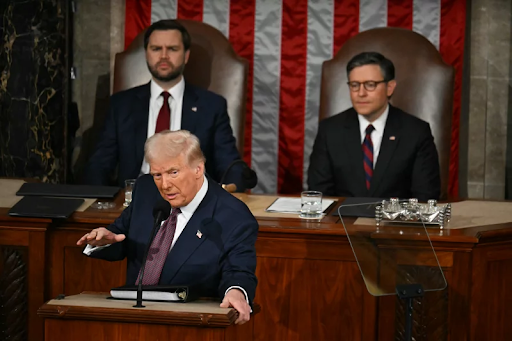
In March 2025 the president focused heavily on immigration. Trump evoked the 1798 Alien Enemies Act which lets the president detain, restrain, or deport nationals of a country during a declared war or invasion. Trump used the act to deport hundreds of suspected Venezuelan gang members. This action by the president led to legal challenges, this policy went before a federal judge who ordered to stop these deportations. At this time the President began to dismantle the Department of Education. A new 25% tariff was introduced on all imported cars and car parts. During March the economy had added 151,000 jobs. At this time the U.S. engaged in relations with foreign nations warning Iran that if they didn’t make a deal on their nuclear program, there would be bombing.
April
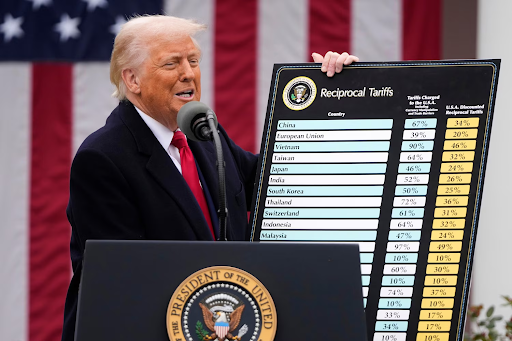
The key events of April 2025 include restoring meritocracy where Trump issued an executive order which aimed to restore meritocracy in federal agencies. The president put new executive orders in place regarding trangender soldiers. In the order it allowed care for gender dysphoria within military facilities. “Hands Off” protests begin to object to his executive orders. Once again Tariffs played a big part in this month’s orders. Many previous tariffs to Canada and Mexico were exempt but some remain. There were many temporary pauses and reductions for countries like China, EU, UK, Japan, South Korea. The administration continued its tough immigration enforcement claiming around 140,000 deportations as of April 2025.
May
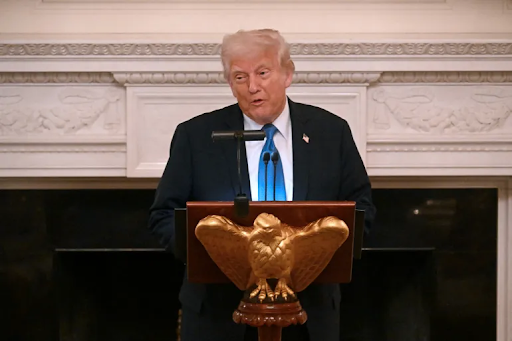
In May of 2025 Trump’s administration focused on economic actions. In early May Trump signed orders to lower drug prices. He signed the “Delivering Most-Favored-Nation Prescription Drug Pricing to American Patients” order. The president’s goal was to have Americans pay no more for brand name drugs than the lowest price offered to comparable “developed nations.” President Trump signed four executive orders in relation to energy development. He addressed AI power demands and boosted the domestic fuel supply. Trump announced a 100% tariff on foreign-made films and a 50% tariff on steel and aluminum.
June
In early June the President signed an order enforcing a new travel ban for nationals from 19 countries. The countries include Iran, Libya, Republic of the Congo, Somalia, Sudan, Yemen, Afghanistan, Burma, Chad, Equatorial, Guinea ,Eritrea, and Haiti. The administration began terminating Harvard University’s Student and Exchange Visitor Program. This was due to alleged fostering of antisemitism. The Department of homeland security is terminating work for some migrants. These actions led to protests, specifically in Los Angeles.
July
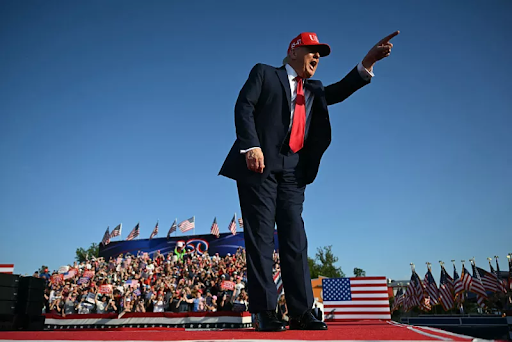
In the beginning of July, Trump signed the “One Big Beautiful Bill Act”. The bill increased crop insurance support for farmers, made big cuts to health insurance, and funded large expansion of immigrants. President Trump unveiled his AI action plan preventing the federal government from using AI models with biases. Trump signed the GENIUS Act. The GENIUS act launched a mission for AI. Trump worked on funding and the future of AI.
August
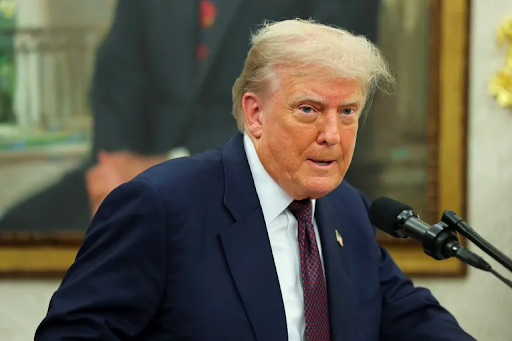
During August, Trump’s administration focused on initiatives like the “Trump Accounts” for children. These accounts improve federal design boosting national security. Trump took this month to continue to address immigration issues. Trump made economic announcements concerning Venezuela, referencing security concerns.
September
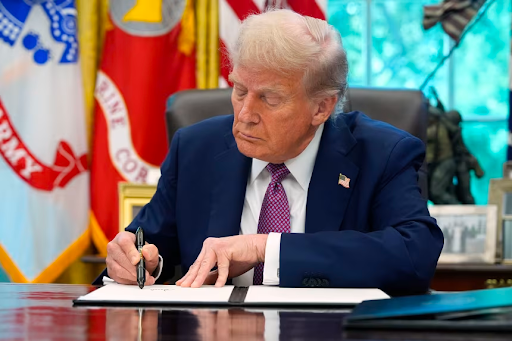
In September, significant actions included tackling autism with Health Secretary Robert F Kennedy Jr. The president changed the name secretary of defense to the secretary of war. The president signed orders like “The Gold Card” for skilled workers who can have a pathway to enter the country legally and again addressed illegal immigration. Trump worked with President Xi of China to keep TikTok operational under American ownership.
October
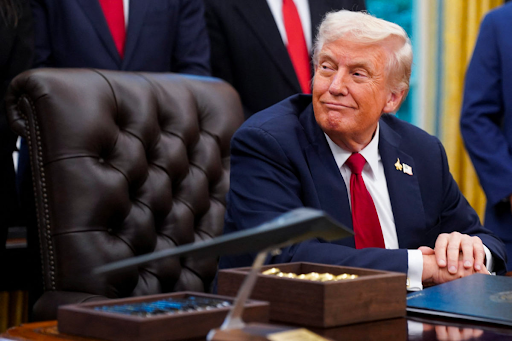
The month of October started with a government shutdown. The shutdown would last 43 days. The administration’s reasoning for the shutdown was the democrats seeking spending cuts. Trump told the Pentagon to begin nuclear testing, despite not doing so since 1992. Trump held briefings for both Columbus Day and Halloween.
November
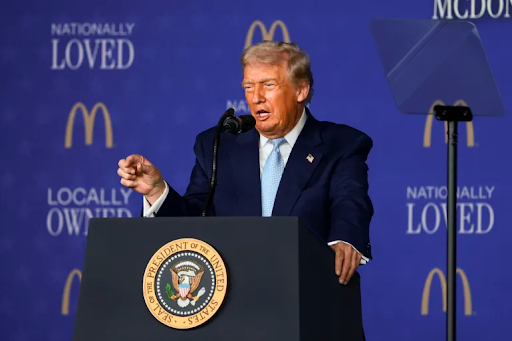
In the beginning of November the government shutdown was still underway, and would end on November 12. The long shutdown heavily affected his approval ratings. Trump held several press conferences on airforce one delivering remarks throughout the month. Later in the month Trump announced lower tariffs on goods from China.
December
In the beginning of December Trump signed an executive order titled “Ensuring a National Policy Framework for Artificial Intelligence”.Trump signed an order considering fentanyl as a weapon of mass destruction. The President announced the “reset” of the Biden Administration’s CAFE standards to levels achievable, aiming to lower car prices for consumers.